
Court Records After Release
A released person may drop from the Bent County Jail current-custody view but remain visible in court data. The court record can show advisement, bond hearing, bond amount, recognizance release, disposition, sentence to jail or probation, mittimus to CDOC, probation review, warrant return, and sealing events. This is especially important in Kiowa County because the jail is outside the county.
How to Check the Court
Use the Colorado Judicial Branch docket search and select Kiowa County when available; the docket search requires a date plus at least one additional filter. Use Colorado State Courts Data Access or CoCourts for court-data/register-of-action context, then request documents from the court when a bond order, sentencing order, mittimus, probation order, disposition, or sealing order is needed.
Combined Court Records and Contact
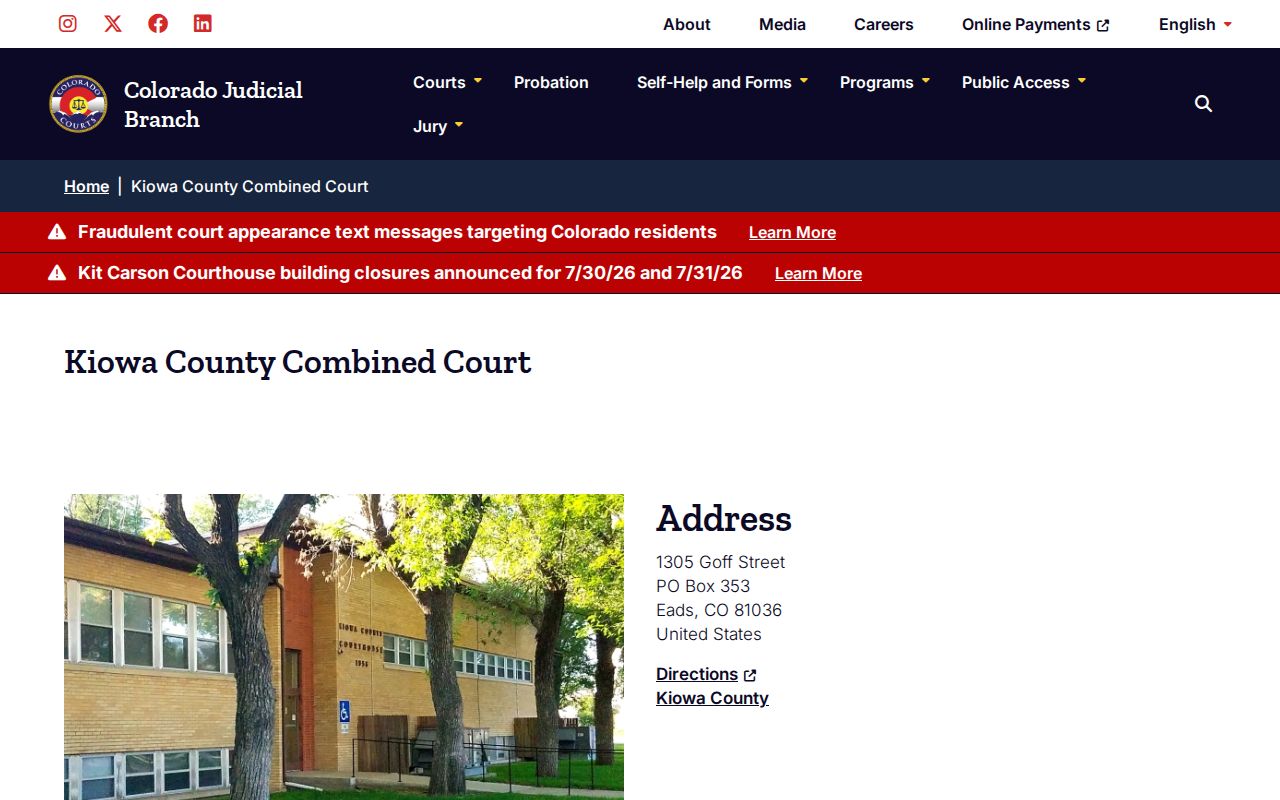
Kiowa County Combined Court
1305 Goff Street, PO Box 353
Eads, CO 81036
Phone: 719-931-6010
Fax: 719-931-0656
Hours: Monday-Thursday, 8:00 a.m.-noon and 12:30 p.m.-4:30 p.m.
For case-file documents, provide the case number if known, party name, date of birth if needed for identification, document type, and date range. Court data is not the same as a certified document.
About the Court Route
Use the court when the release question is legal rather than operational: was bond set, was the case dismissed, was probation ordered, was a DOC sentence imposed, or did a sealing order affect public visibility? Use Bent County Jail for jail release time and CDOC for prison release status.
Court Fields That Explain Release
The court record explains why a person left custody when the jail feed only shows that the person is no longer held. Useful court events include advisement, bond hearing, bond type, bond amount, personal-recognizance release, warrant return or quash, plea, dismissal, deferred sentence, trial disposition, sentence to jail, probation, community corrections, or DOC, jail credit, probation review, revocation, termination, mittimus, and sealing order. Those events can explain whether the jail release was a community release, a transfer, a sentence outcome, or a step in a case that remains pending.
The docket search requires a date plus at least one additional filter. Court-data tools may show a register of action, but they are not the same as certified case documents.
Documents to Request
When a docket entry is not enough, request the specific document from Kiowa County Combined Court or through the Colorado Judicial Branch records request path. Useful documents include bond orders, mittimus records, sentencing orders, dispositions, probation orders, warrant recalls, and sealing orders. Provide the case number if known, party name, date of birth if needed for identification, document type, and date range. A request for the entire case file can be slower and may include restricted material, so a targeted request is usually more useful for release confirmation.
What the Court Does Not Show
The court is not the live jail roster. It may show the order authorizing release before the jail completes processing, and it may show a sentence or transfer after the person leaves the jail. It generally does not replace the Bent County feed for booking number, jail status, or operational release time. It also does not replace CDOC for prison status, the parole-board page for hearing events, BOP for federal prison custody, or ICE ODLS for immigration custody. Use the court to anchor the legal event, then follow the custody system named by that event.
Sealing and Record Visibility
A later sealing order or record-access change can affect what appears in public court and criminal-justice systems. That does not mean the person was never held or that every operational record disappears from every system immediately. If a released-person record appears wrong or should be restricted, start with the agency that published it and use the court order or corrected official record as support. For Kiowa County, that may mean the court for docket and order issues, Bent County Jail for jail feed fields, Kiowa Sheriff for local incident records, or CDOC for prison/parole fields.
Colorado Record Boundaries
Court records are the most durable explanation for a release, but they still have limits. Colorado records rules treat official action differently from investigative material, and court public access can be affected by sealing, restricted filings, protected-party information, and document-specific rules. A docket entry may show an event, while the actual order must be requested from the court. The State Courts Data Access system contains court data, not case documents, and CoCourts describes register-of-action style information.
For a release question, use the court to confirm the legal authority: bond, recognizance release, dismissal, sentence, probation, DOC commitment, warrant action, or sealing. Then verify the physical custody event with the jail, CDOC, BOP, or ICE system that actually held the person.
Kiowa Release Decision Tree
Use a decision tree instead of assuming one database answers every release question. If the person was recently arrested on a Kiowa County matter, begin with the Bent County inmate-info feed and use the arresting-agency filter for KIOWA COUNTY SO or KCSO when available. Read the booking number, date booked, arrest location, status, release date, charges, and current-custody setting. If the feed is unavailable, inconsistent, or urgent, call Bent County Jail or Bent/Kiowa Dispatch at the jail contact number and document the answer given.
If the question is why the release happened, move to Kiowa County Combined Court. The court can explain bond, recognizance release, dismissal, sentence, probation, jail credit, mittimus to DOC, warrant action, and sealing. If the court record shows probation, use Kiowa County Probation and the court order. If the court or jail record shows DOC, DOC Parole, prison sentence, or transfer to state custody, use CDOC offender search and parole-board resources. If the facts point to federal custody, use BOP only for the federal prison track and remember that U.S. Marshals custody can come before BOP. If the facts point to immigration custody, use ICE ODLS and keep county release separate from community release.
When online sources do not match, request records from the agency that controls the disputed field. Ask Bent County Jail for jail booking and release fields, Kiowa Sheriff for local incident or arrest records, the court for orders and dispositions, CDOC for prison or parole fields, BOP for federal prison records, and ICE for immigration custody routing. Keep every request narrow, factual, and tied to custody verification or correction so the custodian can identify the public record being requested.