
Parole Hearing Releases
Parole is a CDOC and Colorado State Board of Parole track. It applies after a prison sentence, not after every Kiowa County arrest. A person may be scheduled for hearing, denied, deferred, granted parole with conditions, rescinded, or released later after a parole plan is approved. That is why a hearing date should be read as a release-stage event, not as the release date itself.
How to Check Hearings
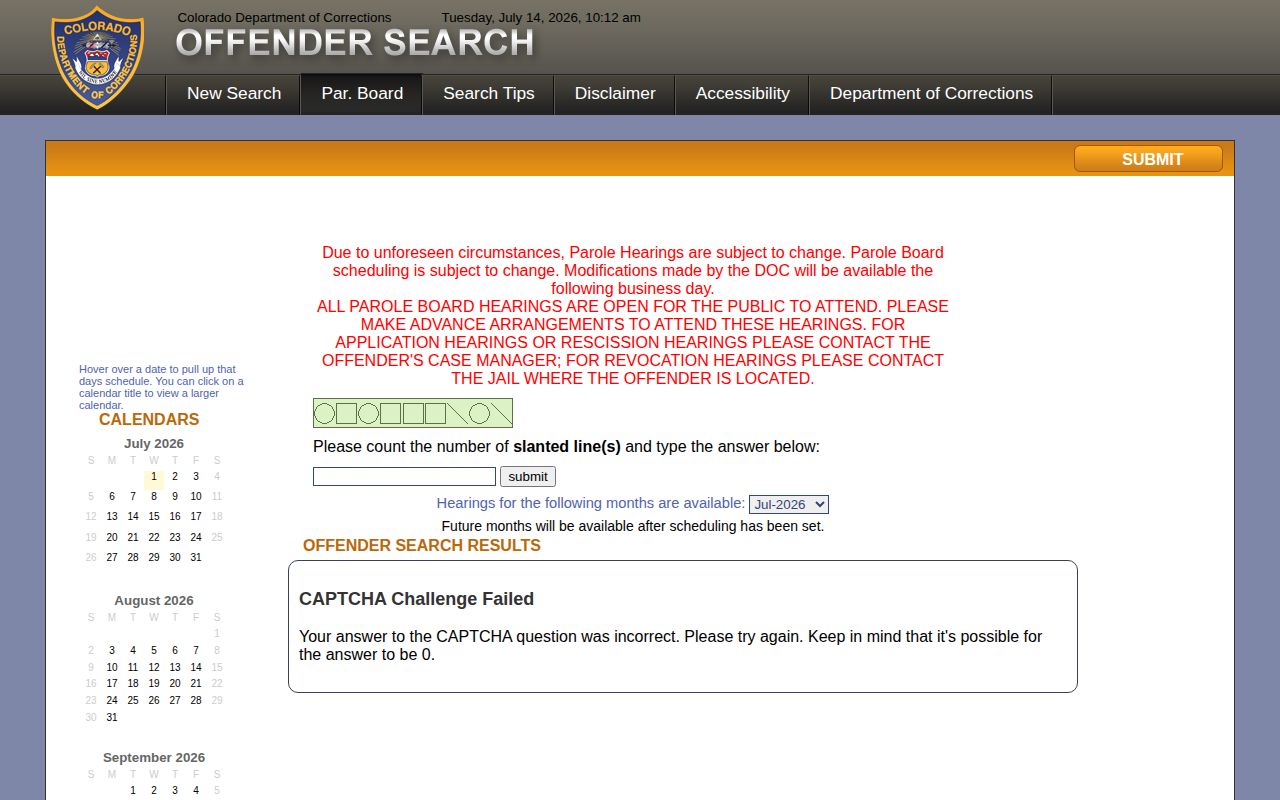
Use the CDOC parole-board search page at doc.state.co.us/oss/index.php?ref=pblist. Search for an individual or review available hearing lists, then cross-check the person's CDOC offender-search result for current status. If the underlying Kiowa case is unclear, use Kiowa County Combined Court to confirm whether a DOC sentence was imposed.
Parole Records and Contact
Colorado State Board of Parole / CDOC
Parole hearing search: CDOC Parole Board list
Offender search: CDOC offender search
For a formal release or supervision record, use CDOC records and the court sentence record. For local jail custody before the prison commitment, use Bent County Jail records.
About Parole Hearing Data
The Colorado Virtual Library describes the parole-board database as a resource for upcoming hearings and related hearing information. It supports state-prison release research, especially when a Kiowa County case moved from court to CDOC and the question is whether a person is approaching parole consideration.
Parole Hearing Fields
A parole-hearing search should be read as a scheduling and decision source, not as a jail roster. The useful fields are the person's identity, DOC number if shown, hearing date, facility or county listing if available, board event, and outcome language. The Colorado Virtual Library source describes the database as searchable by individual, month, or county and says upcoming hearing dates are published. The reviewed source did not publish a precise update cadence, so this page should not claim weekly or daily updates.
Search the CDOC offender record before and after the hearing. The offender record is where custody or supervision status may change after a parole-board event.
Outcomes Are Not Simple Releases
Parole outcomes can include grant, denial, deferment, rescission, revocation-related action, or release after plan approval. A grant does not always mean immediate release to the community, because a parole plan, detainer, program placement, victim-notification process, or rescission issue may remain. A deferment can move the person to a later hearing or mandatory-release date. A denial means the person remains in the state-prison track unless another legal event changes the status. Read the outcome exactly as posted and reconcile it with CDOC status.
Eligibility and Earned Time
Colorado parole eligibility is governed by C.R.S. 17-22.5-403 and related Title 17 provisions. Earned time is governed in part by C.R.S. 17-22.5-405. The parole-board rule definition of Parole Eligibility Date describes the earliest possible parole release date based on sentence length, time served, good-time or earned-time credits, and governing statute as calculated by CDOC. That date is a threshold for consideration, not a release guarantee.
Records After a Hearing
After a hearing, verify in three places. Use the parole-board page for the hearing event and published outcome. Use CDOC offender search for current custody, parole, or discharge status. Use Kiowa County Combined Court for the sentencing record, mittimus, and any local post-sentence docket events. VINE can help with custody-change notifications, but it is not the certified source for the parole decision or the sentencing order.
Colorado Record Boundaries
Parole hearing records sit inside the state-prison release process. Colorado official-action concepts include decisions to grant, order, or terminate parole, but a hearing listing is not the same as a jail release record, a sentencing order, or a complete CDOC file. It should be used to understand the parole-board event and then checked against CDOC offender status. If a hearing result is deferred, granted, rescinded, or otherwise qualified, the exact wording matters.
For a Kiowa County reader, the record chain starts with the court sentence that sent the person to DOC. The parole-board page can show the hearing stage, CDOC can show current status, and VINE may provide notifications. Bent County Jail is only relevant if the person was locally held before prison or later booked on a parole matter.
Kiowa Release Decision Tree
Use a decision tree instead of assuming one database answers every release question. If the person was recently arrested on a Kiowa County matter, begin with the Bent County inmate-info feed and use the arresting-agency filter for KIOWA COUNTY SO or KCSO when available. Read the booking number, date booked, arrest location, status, release date, charges, and current-custody setting. If the feed is unavailable, inconsistent, or urgent, call Bent County Jail or Bent/Kiowa Dispatch at the jail contact number and document the answer given.
If the question is why the release happened, move to Kiowa County Combined Court. The court can explain bond, recognizance release, dismissal, sentence, probation, jail credit, mittimus to DOC, warrant action, and sealing. If the court record shows probation, use Kiowa County Probation and the court order. If the court or jail record shows DOC, DOC Parole, prison sentence, or transfer to state custody, use CDOC offender search and parole-board resources. If the facts point to federal custody, use BOP only for the federal prison track and remember that U.S. Marshals custody can come before BOP. If the facts point to immigration custody, use ICE ODLS and keep county release separate from community release.
When online sources do not match, request records from the agency that controls the disputed field. Ask Bent County Jail for jail booking and release fields, Kiowa Sheriff for local incident or arrest records, the court for orders and dispositions, CDOC for prison or parole fields, BOP for federal prison records, and ICE for immigration custody routing. Keep every request narrow, factual, and tied to custody verification or correction so the custodian can identify the public record being requested.
Source-Specific Check
Before relying on this page's route, compare it with the source that created the event. For parole hearings, that means CDOC status and the parole-board listing; for court supervision, the court order; for registry duties, the local and state registry authority; and for immigration custody, ODLS plus the jail or court record that indicated transfer.